



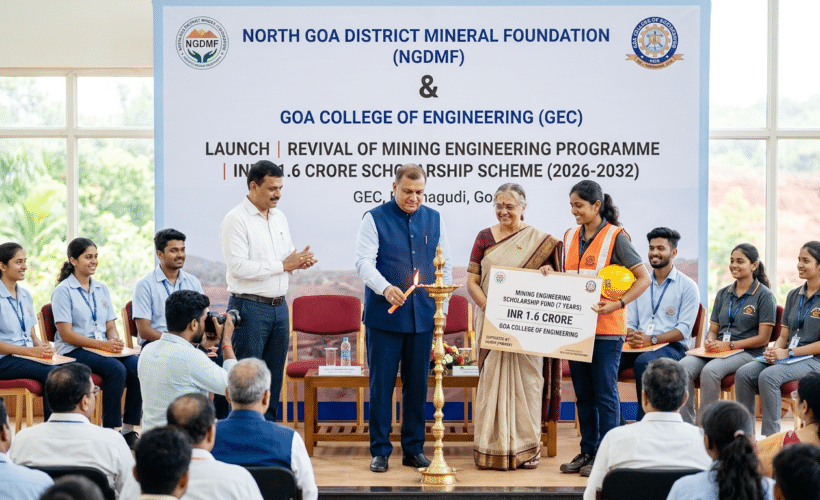
After years of industry-wide shutdowns, the Goa College of Engineering has partnered with the North Goa District Mineral Foundation to fund a new generation of mining professionals.
For decades, iron ore was the undisputed beating heart of Goa’s economy, fueling livelihoods, port activity, and industrial growth across the hinterlands. However, the catastrophic shutdowns in 2012 and 2018 silenced the state’s mining belts, sending severe economic shockwaves through inter-connected businesses and communities. Among the lesser-known casualties of this prolonged downturn was academic interest in the sector itself. The Goa College of Engineering, Farmagudi, which established its dedicated Mining Engineering Department in 2011 to nurture home-grown technical expertise, saw student enrolment plummet in direct proportion to the industry’s demise. By 2019, with no clear horizon for industrial recovery, admissions to the sixty-seat undergraduate programme were officially suspended. A single application received during the 2024–25 academic year underlined a stark reality: local talent had effectively abandoned the discipline.
Now, as fresh iron ore mineral blocks begin operating across the State, a bold strategic intervention aims to unearth a new pipeline of home-grown engineers. In a major push to align academic output with the State’s industrial revival, the North Goa District Mineral Foundation Governing Council has approved a landmark one-point-six-crore rupee financial assistance package proposed by the Goa College of Engineering. The approved scheme will provide comprehensive scholarship support over a seven-year period for students enrolling in the revived programme. Designed to cover four consecutive academic batches running from 2026-27 through 2031-32, the initiative will fund ten students annually who hail specifically from mining-affected regions.
The mechanism behind this initiative leverages statutory provisions under the Pradhan Mantri Khanij Kshetra Kalyan Yojana guidelines, which explicitly permit District Mineral Foundation funds to assist youth from mining-impacted communities pursuing higher education in state and government-aided institutions. While the college initially sought over three crore rupees in combined support from both the North and South Goa District Mineral Funds, this initial allocation provides the financial momentum needed to make the four-year degree attractive and viable once again. College representatives noted during council proceedings that guarantee of financial assistance is essential to encourage students to re-examine careers in mining technology ahead of anticipated sector expansion.
The timing of this academic revival aligns directly with a tangible shift on the ground. With seven iron ore mineral blocks commencing active operations since April 2024 and five additional blocks currently in the pipeline, Goa’s mining industry is entering a modernized phase governed by new leases, updated environmental protocols, and advanced extraction technologies. Re-establishing the degree at Farmagudi ensures that upcoming operations will not have to rely entirely on external talent, but can draw from a talent pool trained locally in Goa’s specific geological conditions and regulatory frameworks.
This educational push forms part of a broader socio-economic reinvestment strategy across the hinterland. Alongside the scholarship approval, the District Mineral Foundation cleared projects worth over six crore rupees targeted at holistic community welfare. These broader initiatives include establishing smart classrooms and a dedicated Digital Learning Centre at Government Polytechnic in Bicholim, introducing rooftop solar subsidies under the PM Surya Ghar Yojana, and extending direct agricultural assistance to farmers operating within mining belts.
Ultimately, the revival of the Mining Engineering Department at Farmagudi is far more than an institutional reset; it represents a major test of confidence in Goa’s economic trajectory.
When mining operations were abruptly halted years ago, it shattered the long-standing belief that a career in the state’s extraction industry offered stability and long-term security. Rebuilding that trust among young students and parents requires far more than financial incentives. It requires proof that the State’s renewed mining framework is built on sustainable practices and enduring policy. If executed effectively, this scholarship scheme will do more than fill empty classrooms; it will ensure that as Goa’s mineral wealth flows again, the technical expertise driving the industry remains proudly home-grown.