



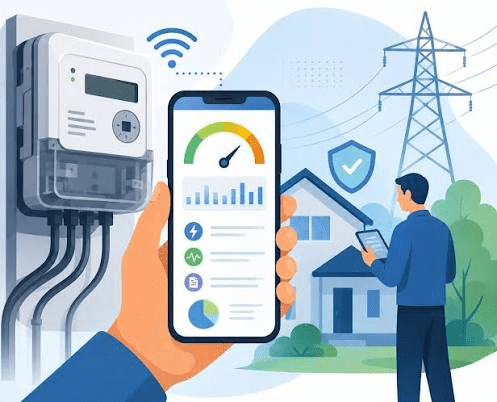
Goa’s smart meter controversy has evolved beyond technology into a wider debate on transparency, governance and the rights of electricity consumers
Goa’s ambitious smart electricity meter roll-out has become one of the State’s most contentious public policy issues, sparking widespread debate over consumer rights, government transparency and the future of power distribution. While the Government maintains that smart meters are essential for modernising Goa’s electricity infrastructure, thousands of consumers remain unconvinced, questioning both the necessity of the project and the manner in which it has been implemented.
At the centre of the controversy lies a simple question: if the Union Government says smart meters are not compulsory, why does the Goa Government appear determined to install them regardless of public opposition?
The answer is more nuanced than it first appears. Smart meters are digital electricity meters capable of transmitting consumption data remotely to electricity utilities. Unlike conventional analogue meters, they eliminate the need for manual meter readings, allow consumers to monitor electricity usage in real time and enable utilities to identify technical faults and electricity theft more efficiently. Across the world, smart metering has been introduced as part of wider efforts to modernise electricity networks and improve operational efficiency.
Goa’s smart meter project forms part of the Government of India’s Revamped Distribution Sector Scheme (RDSS), a centrally sponsored programme aimed at strengthening electricity distribution infrastructure across the country. Under the scheme, states receive financial assistance to upgrade their power systems, with smart metering forming a significant component of the reform agenda.
From the Government’s perspective, the benefits are considerable. Officials argue that smart meters improve billing accuracy, reduce human error, minimise power theft, enable faster fault detection and strengthen the financial health of electricity distribution companies. Digital metering also prepares the electricity network for future smart-grid technologies that can better manage electricity demand as renewable energy generation increases.
However, despite these projected advantages, the roll-out has encountered stiff resistance in Goa. The principal grievance voiced by consumers concerns electricity bills. Numerous households have alleged that their monthly bills increased substantially after smart meters were installed, despite no noticeable change in their electricity consumption. Many residents believe the new meters are recording higher consumption than the previous analogue meters.
The Electricity Department, however, has consistently maintained that smart meters themselves do not increase electricity consumption. Officials have suggested that higher bills may have resulted from corrections to previously inaccurate billing, changes in sanctioned electrical load, or the replacement of ageing meters that may have been under-recording actual consumption. Nevertheless, these explanations have done little to restore public confidence.
Another significant criticism has centred on the alleged lack of transparency during the implementation process. Consumer organisations argue that residents were not adequately informed about the purpose of the new meters, the billing methodology or the technical differences between conventional and smart metering systems. This communication gap has fuelled suspicion and eroded trust between consumers and the Electricity Department.
Political parties have also seized upon the issue. Opposition leaders have organised protests demanding that the Government either suspend or entirely withdraw the smart meter project until all public concerns are addressed. Consumer groups have similarly questioned the legal basis for compelling consumers to replace functioning electricity meters with new digital devices.
The controversy intensified further following statements made by Union Power Minister Manohar Lal Khattar in Parliament. Responding to questions in the Lok Sabha earlier this year, the Union Minister stated that prepaid smart meters were not compulsory and that consumers were not being forced to adopt them. His remarks were widely interpreted as confirmation that smart meters were optional.
Yet, Goa’s Electricity Department has continued to describe the replacement of existing electricity meters under the State’s smart metering programme as mandatory.
This apparent contradiction has become one of the most debated aspects of the entire issue. In reality, the difference lies in the interpretation of what is mandatory.
The Union Minister’s remarks specifically referred to prepaid smart metering, emphasising that consumers would not be compelled to adopt prepaid billing. State authorities, however, distinguish between the installation of a smart meter as infrastructure and the activation of prepaid billing features. According to this interpretation, replacing conventional meters with smart meters forms part of the Government’s responsibility to maintain and modernise the electricity distribution network, while the choice of prepaid functionality remains separate.
Critics argue that this distinction is largely academic from the consumer’s perspective. For many residents, if they are required to accept a new meter irrespective of their consent, the installation is effectively compulsory regardless of whether the billing remains post-paid or becomes prepaid in the future. The issue also reflects India’s federal system of governance.
Electricity is a concurrent subject under the Constitution, meaning both the Union and State Governments have legislative powers in this area. While the Central Government formulates national policy and provides financial support through schemes such as RDSS, the actual implementation of electricity distribution remains largely the responsibility of individual states and their respective electricity utilities.
Consequently, although the Centre may encourage smart metering without explicitly making it compulsory nationwide, state governments retain considerable authority regarding infrastructure upgrades within their own electricity distribution systems.
Recognising the growing public dissatisfaction, the Goa Government recently paused the roll-out of smart meters pending a review of consumer complaints and billing issues. The temporary suspension was welcomed by residents and consumer organisations, although many continue to demand that the project be scrapped altogether unless independent technical verification confirms the accuracy of the meters and greater safeguards are introduced.
Ultimately, the controversy surrounding smart meters in Goa is not merely a debate about technology. It is fundamentally a question of governance, transparency and public trust.
Few dispute that electricity infrastructure requires modernisation. Digital technologies have the potential to improve efficiency, reduce losses and create a more resilient power network. The challenge lies in ensuring that technological progress is accompanied by clear communication, robust consumer protections and transparent implementation.
If consumers believe that new technology is being imposed without adequate explanation or without addressing legitimate concerns about billing accuracy, opposition is likely to persist regardless of the technical merits of the project.
For the Government, rebuilding public confidence may prove just as important as installing new meters. Independent testing of smart meters, greater transparency regarding billing practices, accessible grievance redressal mechanisms and sustained public engagement will all be essential if the modernisation programme is to achieve widespread acceptance.
As Goa continues to review its smart meter rollout, the State finds itself balancing two equally important objectives: embracing the future of digital electricity management while ensuring that consumers remain informed, protected and confident in the system designed to serve them.