



Keegan Furtado elaborates on why returning to work too fast after the holidays feels harsher than it needs to be
If you have spent any time on Instagram in December, you would have met the Grinch. Not the book version, or the original animated classic, and certainly not the Jim Carrey version dialled up to theatrical chaos one, redeemed at the end of the book / film. This Grinch pops up in reels, usually in a furry green and red suit, yanking gifts out of kids’ hands, knocking over Christmas trees, stealing snacks, and ruining festive moments with theatrical enthusiasm. Children cry. Adults laugh. Someone always films instead of intervening
The joke, of course, is that the Grinch is not meant to be taken seriously. He is chaos in a costume. A festive villain whose entire purpose is to wreck the mood.
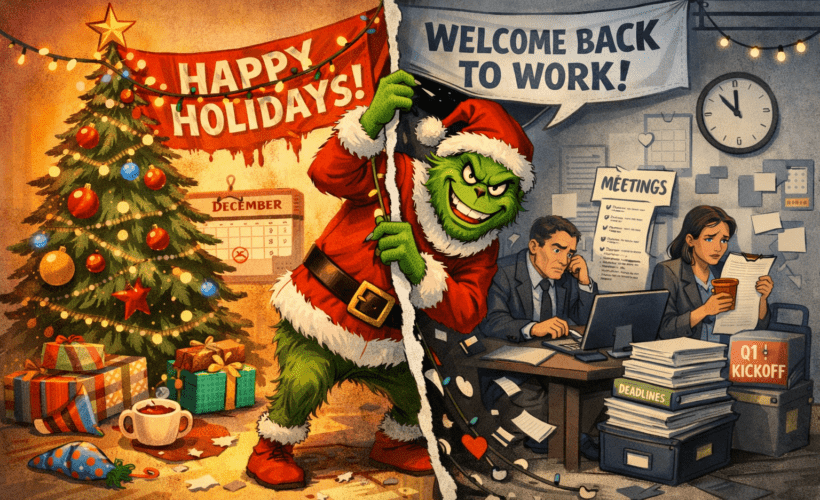
And then January arrives, and somehow, the Grinch gets promoted. Because the post-holiday return to work feels suspiciously similar. The decorations come down, the cheer evaporates, and someone snatches the last remaining sense of calm with a meeting invite titled ‘Kickoff.’ The Grinch may have left Instagram, but he has moved into the workplace.
The Great January Heist
One moment, people are easing into mornings, surviving on leftovers and low expectations. The next, they are back at their desks, staring into inboxes that look like they have been quietly multiplying in the dark.
The holiday glow does not fade gently. It is taken. Yanked away by urgency, productivity theatre, and the unspoken assumption that everyone is instantly ready to operate at full speed. Much like the Grinch in the films, there is no gradual build-up. Just sudden disruption.
The return to work is not meant to be a dramatic snap back to reality. It is meant to be a transition. Yet many organisations treat it like a switch. Off. On. Back to business.
The Myth of Instant Recovery
In every Grinch movie, there is a moment where he assumes that removing the presents will destroy Christmas entirely. He is wrong, of course. Joy proves more resilient.
Workplaces, however, make a different mistake. They assume that holidays fix everything. That rest is immediate, complete, and permanent. It is not.
Holidays involve travel fatigue, disrupted routines, family politics, emotional processing, and the strange shock of having time to think. People return restored in some ways, depleted in others, and very much in transition. When organisations ignore this, they recreate the Grinch effect. Warmth is replaced with pressure. Rest becomes something to justify. Recovery becomes suspicious.
How the Grinch shows up at work
The workplace Grinch does not wear a Santa suit or live on a mountain. He lives in behaviour. He appears in packed calendars during the first week back. He lurks in full-year strategies unveiled before people have cleared their inboxes. He speaks in phrases like “Let us hit the ground running” and “We cannot afford to lose momentum.” In the movies, the Grinch’s theft is dramatic but temporary. In organisations, the impact lingers. Morale, unlike presents, is not easily returned once it is taken away.
Why this matters more than we think
The first few weeks of January quietly set the emotional tone for the year
If the message is that rest was indulgent and must now be corrected, employees learn to withdraw. Not loudly, not rebelliously, but subtly. They become cautious with energy. They contribute carefully. They disengage just enough to protect themselves.
This is often where quiet quitting truly begins. Not with entitlement, but with repeated experiences of having recovery stolen too quickly.
A better way to return
This is not an argument for indulgence or lowered expectations. It is an argument for better design. January works best as a recalibration phase. Fewer meetings. Clear priorities. Space to reflect before accelerating. Time to reconnect before performing. Leaders who acknowledge that people are re-entering, not restarting, build trust. Teams that ease back in sustain performance longer. Momentum, when earned gradually, tends to last.
Leaders’ moment to play Cindy Lou Who
In every Grinch movie, it is not force that changes him. It is perspective.
Leaders have that role in January. It can challenge unnecessary urgency and ask better questions. Do we need this meeting now? Can goals be phased? Are we measuring output or visibility?
Sometimes, the most strategic thing leaders can do is protect the holiday glow just long enough for it to turn into genuine engagement.
The Bottom Line
The Grinch in Instagram reels is entertaining because he eventually leaves. The damage is temporary. The gifts are returned. In the workplace, the Grinch rarely gives things back. When we rush people back into full speed, we steal energy, goodwill, and motivation without realising it.
January does not need to be gentle. It needs to be thoughtful.
Because when the holiday glow disappears overnight, it is rarely because people are lazy. It is because someone, somewhere, thought it would be funny to snatch it away.
And that, more than any furry green costume, is the real Grinch move.
The writer is a Deputy General Manager – Talent Development and Learning at Digitide Solutions and is a Certified Practitioner and Life Coach Email: keegan1694@gmail.com