



From Swiss kitchens to a 10-acre estate on the Goan border, Chef Alvinia De Souza is building a single-origin cacao empire from the ground up
To understand Chef Alvinia De Souza’s craft, one must look past the tempering bowl and into the soil. She grows chocolate, tempers it, turns it into single-origin bars, bakes it into delicate pastries, and even brews its discarded husks into tea. While she defines her daily work as a baker, pastry chef, chocolate maker, and chocolatier, the foundation of her entire enterprise rests on a title she earned through relentless trial and error. “And, I am a farmer,” she says proudly, having built a 10-acre estate from the ground up on the Goa-Maharashtra border.
Her entrepreneurial journey represents a seamless integration of sustainable agriculture and direct-to-consumer craft gastronomy. Driven by a decade-old vision to grow, process, and sell her own cacao, Alvinia created DoDā, a small-batch craft chocolate brand, alongside DoDā Atelier, a forest-green and gold accented café and pastry shop in Goa that serves as both a retail space and culinary canvas for her farm’s yield. Alvinia’s path to single origin chocolate was anything but conventional. Armed with a background in pharmaceutical chemistry, she initially returned home to Goa to assist in her family’s business before pivoting to her true passion; studying pastry and chocolate arts in Switzerland, followed by five years at a bakery on the outskirts of Bern.
While honing her technical skills in Swiss kitchens, a persistent realization took hold. Precision and respect for raw materials were paramount in Europe, yet many primary ingredients were imported from afar. The turning point arrived during a weekend journey through Europe when she stumbled upon a bean-to-bar chocolate labeled Single Origin: India.
“That was that moment when I thought, what am I doing here?” Alvinia recalls. “An ingredient is celebrated all the way back in Europe, and all this exists right in our country.” Discovering that Indian cacao beans, fermented by an Italian expat sourcing pods across South India, were being exported directly to boutique European makers, she resolved to bring Swiss discipline back to Indian soil. In 2018, Alvinia acquired a 10-acre parcel of land in Dodamarg. The land was entirely barren, presenting an intimidating agricultural challenge. “If I had the knowledge of agriculture back then, I wouldn’t have picked the land I did,” she admits. Because cacao originates in the Amazon rainforest under-canopy, planting saplings directly into scorched, depleted soil was impossible.
To regenerate the ecosystem, she initiated a multi-year soil-healing process; planting shade-providing banana trees, mango trees, and native forest species to recreate a micro-climate, while incorporating heavy natural mulching and organic inputs sourced from local dairy farmers. The early years brought trials ranging from severe wild animal intrusions to unpredictable weather, leading to moments where giving up felt tempting. But nature taught her patience. By adopting natural farming practices and taking online agronomy courses, she established a thriving, biodiverse food forest capable of supporting high-yield cacao saplings.
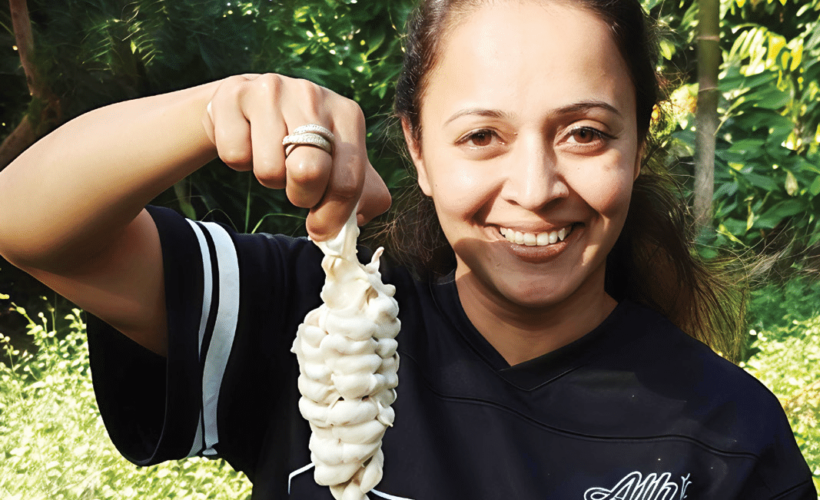
Transforming a raw cacao pod into a finished DoDā bar requires rigorous control across every stage. Once harvested, the pods are opened to reveal seeds surrounded by a sweet, mucilaginous pulp, which is crucial for fermentation. During this phase, natural sugars break down into acids that lay the groundwork for future flavor profiles. The beans are then sun-dried, roasted, winnowed into nibs, and stone-ground for 24 to 72 hours to achieve micro-refinement before being tempered and hand-wrapped.
Through extensive trials, Alvinia settled on a 65% and 75% dark chocolate range to best express her estate’s terroir. The flavour profile is rounded and complex, featuring natural fruitiness and subtle nutty undertones. The micro-climate also creates distinct seasonal characters: a pre-monsoon harvest yields an earthier, deeper, and nut-forward profile, whereas a post-monsoon harvest produces a higher acidity with brighter, fruit-forward notes due to soil moisture saturation. For Alvinia, craft chocolate is not about producing identical bars year after year, but honoring the natural variation of each harvest.

When asked which stage brings the greatest fulfillment, Alvinia’s answer reflects her evolution as a grower. “When I planted the trees, I initially thought the greatest satisfaction would be the moment I tasted the chocolate made out of my cocoa,” she says. “But after all these years of farming, my perspective has changed. Today, the most satisfying part is actually the harvest; walking through the farm, reaching out, and plucking a ripe cocoa pod from the tree.”

At DoDā Atelier, she translates that harvested yield into a rich culinary experience. Rather than relying on commercial compound chocolate, every item on her menu uses her own farm-grown craft chocolate. The café showcases various chocolate concoctions, especially a rich, thick dark chocolate and classic creations like rum balls, accentuating how craft chocolate elevates regional ingredients.
To educate guests about the whole fruit, Alvinia utilizes every part of the cocoa pod. She brews aromatic tea from the roasted outer shells, crafts husk ice cream, and prepares refreshing coolers from the sweet, tangy fruit pulp. Alongside pairings like local mango, chili, and sea salt, she is introducing new combinations like tonka bean paired with local bananas.
For first-time visitors, her signature hot chocolate remains non-negotiable; an indulgent, liquid chocolate experience that offers a direct taste of the farm’s harvest.
While states like Kerala, Karnataka, and Andhra Pradesh have established strong footprints in India’s craft chocolate movement, Alvinia is championing Goa’s entry onto the national stage. She actively encourages local farmers to intercrop cacao, highlighting its resilience and economic viability.
Her vision extends well beyond her own brand. By building a supportive ecosystem for thoughtful, sustainable cacao cultivation, Alvinia aims to earn Goan cacao a permanent seat at the national table. “I am here to speak for Goan cacao today,” she says. “But in the future, I want Goan cacao to be recognized and respected all on its own.”