



GCCI leads the charge in integrating FPOs, heritage Kulagars, and agro-eco tourism to power Goa’s next economic renaissance
For decades, the economic narrative of Goa has been largely anchored to its sun-drenched coastline, heritage architecture, and bustling hospitality sector. However, away from the crowded beaches lies a quiet, highly lucrative movement that is reshaping the state’s economic landscape: Agro-Eco Tourism. By bridging traditional agrarian practices with modern experiential travel, Goa is unlocking a high-value economic engine that diversifies its tourism footprint while breathing new life into rural communities.
Agro-eco tourism represents a natural, high-margin evolution for the region. Modern travelers increasingly seek authentic, sustainable, and immersive experiences; moving away from passive sightseeing toward active engagement with local ecology. In Goa, dense spice plantations, organic orchards, and traditional farming ecosystems offer an ideal environment for this market demand. Visitors are eager to understand seed-to-table culinary traditions, explore biodiversity, and participate in rural living.
The financial and developmental benefits of agro-eco tourism are far-reaching:
– Revenue Diversification: Farmers transform seasonal harvest cycles into year-round, service-sector income streams by welcoming eco-tourists, conducting guided farm tours, and hosting home-stays.
– Direct-to-Consumer Margins: Local producers bypass intermediaries, selling organic produce, artisanal spices, processed foods, and traditional crafts directly to tourists at premium retail values.
– Youth Retention and Employment: The sector creates diverse jobs in eco-hospitality, guiding, local gastronomy, and logistics, incentivizing educated youth to remain in rural belts rather than migrating to urban centers.
– Ecological Resilience: It financially rewards land preservation, encouraging farmers to maintain rich biodiversity and organic techniques rather than selling land for commercial development.
Institutional Aggregation, Policy Reforms and Cultural Heritage
While agro-eco tourism drives consumer demand into Goa’s hinterlands, structural challenges have historically constrained individual smallholders. Small landholdings, rising mechanization costs, and supply chain fragmentation often limit a farmer’s operational efficiency. Overcoming these barriers requires institutional modernization, supportive policy frameworks, and the preservation of traditional systems.
Harnessing the power of FPOs for Market Scale
Highlighting the roadmap for structural reform, Nikhil Desai, IAS, Secretary, Agriculture, Government of Goa; emphasized the pivotal role of the Farmer Producer Organisation (FPO) model in driving Goa’s agricultural resurgence.
“The FPO model holds immense potential to bring about a sweeping agricultural transformation in Goa. It enables farmers to achieve a steady, organized supply of agricultural produce while collectively addressing growing market demands,” said Desai
FPOs function as collective business entities that aggregate small-scale production to achieve economies of scale. By organizing into FPOs, Goan farmers gain:
– Collective Bargaining Power: Lowering the purchase cost of high-quality seeds, fertilizers, and equipment.
– Enhanced Market Access: Meeting the volume and quality consistency demanded by major hospitality chains, retail buyers, and export markets.
– Value Addition and Branding: Enabling collective investment in post-harvest processing, cold storage, packaging, and branding; turning raw commodities into high-value packaged goods.
Through collective aggregation, FPOs enable local producers to capture high-margin supply contracts that were previously dominated by out-of-state suppliers.
Strategic Policy Victories: GCCI Advocacy
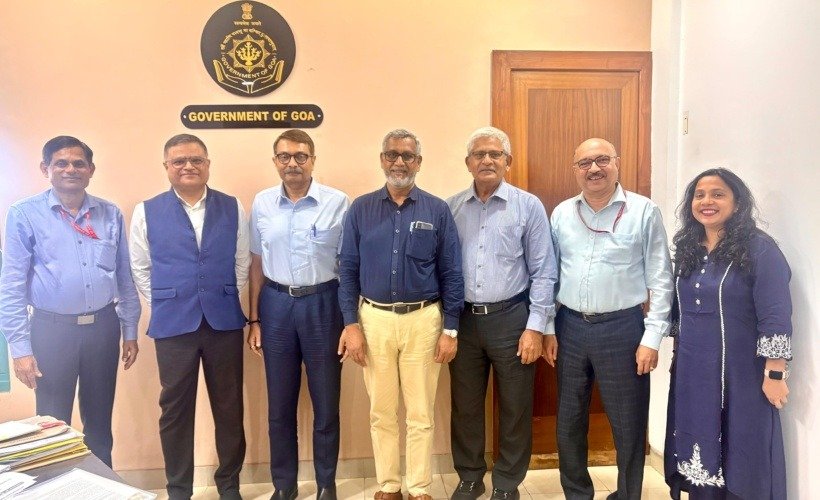
A delegation of the Goa Chamber of Commerce & Industry (GCCI) led by Mahesh Patil, Chairman, Agriculture Committee, and Dr Sangam Kurade, Mentor, Agriculture Committee; met Nikhil Desai, IAS, Secretary (Agriculture), recently in the presence of Chandrahaas Desai, Director of Agriculture and submitted GCCI’s recommendations on the Goa State Agriculture Policy.
The delegation included Joseph D’Souza (member Managing Committee of GCCI), Sanjay Amonkar, Director General, GCCI, and Ambika Dhakhenkar, Deputy Director, GCCI.
During the meeting, GCCI presented a detailed set of recommendations aimed at strengthening Goa’s agricultural sector, improving farmer incomes, promoting modern agricultural practices and creating stronger linkages between farmers, markets and industry
The movement toward a modernized agricultural economy recently achieved a major milestone. The GCCI Agriculture Committee successfully advocated for key policy shifts, with the state government accepting two critical GCCI recommendations:
- Comprehensive Input Subsidy on Agricultural Equipment (including GST)
Financial barriers have long hindered smallholders from adopting modern machinery. By extending input subsidies to cover the overall cost of agricultural equipment including GST; the government directly reduces capital expenditure for farmers. This policy makes modern mechanization accessible, lowers labour dependencies, and significantly improves farm productivity across the state.
- Engaging Agriculture Graduates as ‘Agri-preneurs’:
To bridge the gap between academic research and field-level practice, the government approved initiatives to engage agriculture graduates as professional agri-preneurs. Whether through self-employment ventures (such as custom-hiring centers, organic certification consultancies, and modern nurseries) or as professional advisors to local farmers, these young professionals bring technical expertise, digital tools, and business acumen straight to rural farms. This initiative simultaneously solves youth employment while professionalizing the sector.
Preserving Agrarian Roots
Economic modernization in Goa does not mean abandoning traditional wisdom. At the heart of Goa’s ecological identity is the traditional Kulagar; a sophisticated, multi-tiered farming system designed centuries ago to cultivate betel nut, coconut, black pepper, cardamom, banana, and nutmeg within self-sustaining micro-climates.
To honour this ecological heritage, the GCCI delegation announced its intention to celebrate ‘Kulagar Day’ on 13th December, marking the birth anniversary of late Manohar Parrikar, the former Chief Minister of Goa.
Known for his vision of sustainable infrastructure and economic self-reliance, Parrikar’s legacy aligns naturally with rural revitalization. The proposed ‘Kulagar Day’ initiative aims to:
– Elevate public awareness about the ecological and economic importance of traditional Kulagar systems.
– Drive policy and community efforts toward the conservation and scientific revival of these spice orchards.
– Formally recognize the vital contribution of traditional farmers to Goa’s cultural heritage, environmental sustainability, and agro-tourism appeal.
A Blueprint for Rural Goa
Goa’s agricultural ecosystem is entering a promising era of transformation. By positioning agro-eco tourism as a high-value commercial driver, implementing FPOs for operational scale, leveraging GCCI-backed government subsidies and agri-preneurship, and honouring traditional Kulagar systems, the state is creating a resilient rural enterprise model.
This integrated strategy proves that economic development and environmental conservation can thrive together. By combining institutional scale with traditional ecological wisdom, Goa provides a compelling blueprint for how regional economies can transform farming from a subsistence activity into a modern, profitable, and sustainable business sector.