



Purple Martini has turned the Anjuna sunset into more than a view – it is the beginning of an experience where food, cocktails, design and entertainment come together
Purple Martini does not simply enjoy the Anjuna sunset; it stages an entire evening around it. Set high above the Arabian Sea, the restaurant occupies that rare space between coastal dining room, spirited sundowner and a rather glamorous Mediterranean escape.

Its whitewashed surfaces, vivid blue accents and breezy cabanas evoke a Goa imagined somewhere between the Konkan coast and Santorini. The design is deliberately theatrical, but the setting can withstand the flourish. As the sun begins its descent, the Arabian Sea assumes centre stage and everything else becomes part of the supporting cast. The spectacle, however, did not arrive by accident. Saarthak Gupta studied at the University of Leeds before identifying what he saw as a vacuum in India’s nightlife landscape and setting up Purple Martini in 2008. The larger dream found its natural stage in Goa in 2014, when Purple Martini at Sunset Point opened as a seaside restaurant and bar. What began as a passion venture has since become one of Anjuna’s most recognisable sunset addresses.
Gupta’s business instinct lies in understanding that hospitality is not merely about selling food and drink. It is about controlling the rhythm of an occasion. Purple Martini was built around a reliable piece of theatre, the sunset, but its commercial intelligence lies in giving guests reasons to arrive before it and remain long after.
The property now extends across five levels and accommodates roughly 700 guests, growth Gupta attributes to continual innovation, from performance acts and dancers to ideas drawn from hospitality around the world.
There is also a telling entrepreneurial continuity here: Gupta did not abandon the original nightlife proposition when Goa beckoned; he translated it, allowing destination, design, food and entertainment to widen the audience without diluting the brand.
The space consequently changes character as the day progresses: languorous by afternoon, convivial at sunset and considerably more bacchanalian once the music, cocktails and night take over. This is not accidental mood lighting. It is day parting with better cheekbones.
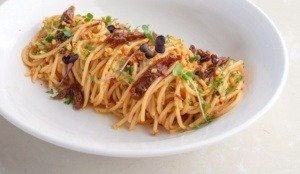
Thankfully, the kitchen is not entirely distracted by the scenery. The Polichadhu Fish, Purple Martini’s interpretation of a dish from Kumarakom, is particularly worthy of attention. Fish marinated with tomato and onion is wrapped in banana leaf and cooked with coconut oil: fragrant, comforting and refreshingly rooted in something more meaningful than Instagrammability.
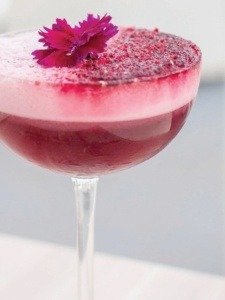
Pair it with the Citrus Bonbon and things become interesting. White rum infused with orange peel, cacao nibs and peppermint extract arrives over ice, accompanied rather mischievously by a Ferrero Rocher and orange zest. On paper, it sounds like several ideas arguing at once. In the glass, they make surprisingly amicable drinking companions.
The Murg Shola Tikka brings proceedings firmly northwards: succulent chicken smoked with aromatic spices and dark rum. It is robust, smoky and demands a piping hot naan alongside. Some dishes need culinary analysis. Others require bread. This is happily the latter.
And then there is The Dessert Bar, where handcrafted rolled ice creams provide a suitably theatrical finale. The Brownie Baileys deserves particular attention: rich, boozy and wholly unconcerned with restraint.
Seen through a business lens, Purple Martini’s evolution makes sense. Gupta has treated location not as decoration but as intellectual property. The 180 degree sea view, Mediterranean visual language, entertainment programming and broad food and beverage offering work together as one memorable product.
The model is built for multiple audiences without appearing to negotiate with any of them: families at lunch, sunset pilgrims with phones poised, diners, cocktail drinkers and the late night crowd. Each arrives for a slightly different Purple Martini, yet each recognises the same brand.
That may be Gupta’s neatest piece of acumen. In a market where restaurants often confuse novelty with identity, he has repeated and enlarged one clear promise rather than endlessly reinventing it. The business has expanded since the Goa venue’s inception, but the founding proposition remains legible: give people a setting dramatic enough to travel for, then create sufficient energy, food and theatre to keep the table occupied.
This is not a place that whispers its intentions. It is flamboyant, photogenic, occasionally excessive and knows precisely what it is selling. Yet beneath all the spectacle lies its cleverest achievement: it makes people want to stay.
Come for that famous sunset, certainly. Stay for dinner. Order another cocktail. Find the Brownie Baileys. We assure you, Anjuna will still be there tomorrow.