



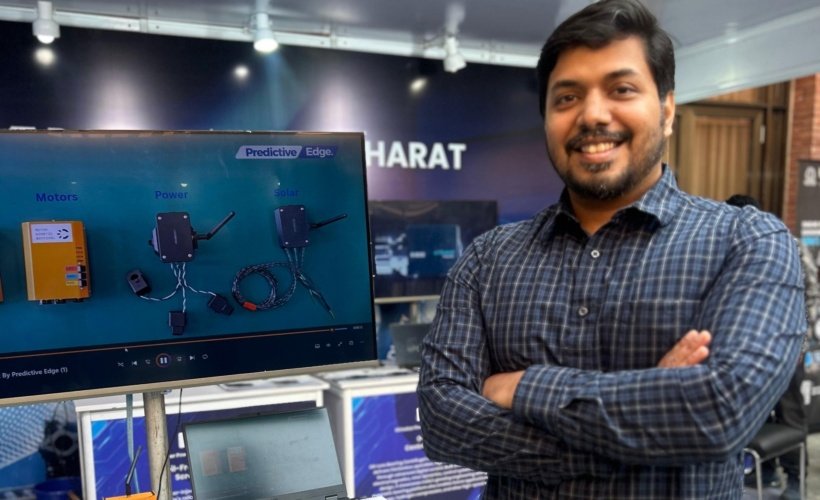
From generator sets and sheet-metal lines to wind turbines, Predictive Edge Technologies demonstrates how homegrown deep-tech is solving complex manufacturing challenges.
Goa-based Predictive Edge Technologies, founded by Raunak Deepak Kamat, a IISc Gold medallist from the 2019 batch of the Department of Design and Engineering and backed by the Pai Kane Group, is developing a self-powered, plug-and-play machine-health monitoring platform that could transform industrial maintenance. Supported by the Ministry of Heavy Industries’ SamridDHI accelerator at IISc, the startup is demonstrating how homegrown engineering can address complex industrial challenges.
In an era where industrial efficiency, automation and intelligent manufacturing are becoming increasingly important, a Goa-based technology startup is working on an innovation that could change how factories can condition monitor its machines and preempt failure.
Predictive Edge, has developed a condition-monitoring platform designed to identify potential equipment failures before they result in production disruptions and loss of revenue.
For manufacturing companies, where every minute of downtime can translate into significant financial losses, this innovation presents an opportunity to improve operational reliability without disrupting production.
A test bed close to home
Predictive Edge did not have to look far for its first test bed. The earliest trials of its monitoring hardware were carried out on generator sets built by the Pai Kane Group, the Goa-headquartered manufacturer of generator sets, transformers, compact substations and switchboards, which, through Power Engineering India and Sheffield, UK – based Ward Power, exports to more than 86 countries.
Gensets made for a demanding first subject
A generator set is at once an engine, a rotating machine and a source of electrical power, so early prototypes had to make sense of vibration, temperature and electrical behaviour together, under real load rather than on a laboratory bench. Working on the group’s own machines also meant the team could test, adjust and re-test quickly, the kind of rapid iteration that is difficult to arrange at a customer’s site.
The Pai Kane Group’s involvement goes well beyond lending its machines. Atul Pai Kane, Chairman and Managing Director of the Group, is also a co-founder of Predictive Edge, and Raunak and he work closely together in building the business.
The division of roles is clear. Raunak leads product development and customer engagement, while the Pai Kane Group supports the company with its shared services, taking care of the back-office functions that tend to consume a young company’s time, and brings the commercial acumen of a business that has been selling industrial equipment for more than three decades. “Raunak builds the product and stays close to the customer. Our job is to make sure nothing slows him down,” says Atul Pai Kane.
Innovation born on the factory floor
The idea for its self-powered sensor, meanwhile, can be traced to an early industrial deployment at IFB’s sheet-metal stamping lines in Goa.
Installing conventional monitoring equipment required shutting down machinery for approximately 30 to 40 minutes. Technicians had to mount sensors, access electrical panels and arrange external power connections.
While such interruptions might appear insignificant, they can be particularly inconvenient in manufacturing environments where production schedules are tightly managed.
The experience prompted the Predictive Edge team to reconsider the fundamental architecture of industrial monitoring equipment.
Could a sensor be installed on a running machine without interrupting operations? Could it function without batteries or external power? And could it generate meaningful diagnostic information rather than merely transmitting measurements?
These questions became the foundation of the company’s technological development.
A Sensor that powers itself
Predictive Edge’s patent-pending innovation uses an ingenious engineering principle; harvesting energy from the magnetic field surrounding a current-carrying electrical conductor.
Its clamp-on motor-health node converts this energy into regulated electrical power, enabling the device to operate without an internal battery or external power cable.
The company has demonstrated operation at currents above approximately 10 amperes. Importantly, the device separates energy harvesting from diagnostic measurement. One magnetic core generates power, while dedicated current transformers capture electrical signals required for accurate analysis.
This dual-core architecture addresses a significant technical challenge. A component optimised for generating energy may not necessarily capture the detailed frequency information needed to detect developing motor faults.
By separating these functions, Predictive Edge has created a system designed to deliver both energy independence and diagnostic accuracy.
The non-invasive installation also reduces the need for electrical modifications and eliminates routine battery replacement. This is particularly useful for Oil and gas and sites which require Atex approvals.

Intelligence at the Edge
The company’s innovation extends beyond its self-powered sensor.
Its broader Motor Kinetic Sentinel platform combines electrical-current monitoring, vibration analysis and temperature sensing to assess equipment health.
The technology uses Frequency domainfor processing and physics-based fault detection to analyse machine behaviour.
Rather than simply reporting when a measurement exceeds a predetermined threshold, the system is designed to identify patterns that may indicate developing mechanical or electrical problems.
Another distinguishing feature is its edge-computing architecture.
Instead of depending entirely on cloud-based processing, diagnostic analysis can be performed closer to the monitored equipment. This reduces dependence on continuous internet connectivity and supports faster access to actionable information.
The platform can operate through cloud infrastructure or dedicated offline servers, making it adaptable to industrial organisations with strict cybersecurity and data-sovereignty requirements.
Its modular architecture supports applications across motors, generators, electrical distribution systems and other industrial assets.
From Goa to Industrial Applications
Predictive Edge’s development has involved extensive field experimentation, with each deployment providing opportunities to refine the technology.
Following its initial work at IFB, the company tested its monitoring platform in the wind-energy sector.
A pilot installation on one wind turbine, within a fleet of approximately 150 similar machines, demonstrated the system’s ability to identify faults requiring investigation within the first month.
The application presented additional engineering challenges, including elevated operating temperatures and the integration of independent turbine and SCADA data.
Such deployments have helped the company move beyond laboratory demonstrations towards practical industrial validation.
The platform’s versatility has also enabled Predictive Edge to explore applications outside conventional machine monitoring.
For Molbio Diagnostics, the company co-developed a portable charging system alongside another Pai Kane Group company, Solray Solutions LLP for medical equipment deployed in African field programs.
It initially manufactured 500 units, followed by approximately 300 additional units. The engagement subsequently expanded to a power product for portable X-ray equipment.
Other applications include fuel-retail hygiene monitoring, submersible turbine-pump protection and generator telemetry. The last of these, which includes systems involving CAN bus interfaces and CPCB IV+ requirements, grew naturally out of the company’s early testing on Pai Kane generator sets.
These projects demonstrate how a common technological platform can support multiple commercial products.
The IISc and SamridDHI Advantage
An important part of Predictive Edge’s development journey has been its association with SamridDHI, a strategic product accelerator of the Ministry of Heavy Industries, implemented by the Foundation for Science Innovation and Development (FSID) at the Indian Institute of Science, Bengaluru.
For deep-technology startups, transforming a prototype into a commercially viable industrial product requires much more than an innovative idea.
Engineering validation, calibration equipment, manufacturing partnerships, regulatory compliance and working capital are equally important.
Through SamridDHI, Predictive Edge received capital support, technical guidance, shared infrastructure and assistance with operational requirements, including accounting, legal and administrative functions. The program also helped strengthen the company’s manufacturing ecosystem.
PEPL has associated with the accelerator’s cohort, manufacturing its printed circuit boards, providing a domestic production arrangement capable of expanding with demand.
The company’s product is CE marked, while an ATEX-ready design is available on request for applications involving potentially hazardous industrial environments.
Building a Scalable Business
Having established its technological foundation, Predictive Edge is now looking towards larger industrial deployments.
Discussions with major steel companies indicate a potential requirement of approximately 400 monitoring units across three plants.
The company has also completed a pilot with a large telecom tower company, with a proposed order of approximately 12000 units described as approaching confirmation.
These opportunities remain in the commercial pipeline and should not be confused with completed deployments.
To support expansion, Predictive Edge is preparing a seed-funding round aimed at strengthening manufacturing equipment, calibration facilities, field-service capabilities and replacement inventory.
This is where the Pai Kane Group’s commercial experience becomes a practical asset. Pricing, contracting and supplying large industrial buyers is familiar territory for the group, and it allows Raunak and his team to stay focused on the technology and the customer as pilots turn into volume orders.
The company’s next challenge will be demonstrating that its technology can deliver consistent performance across larger installations while building the service infrastructure required by industrial customers.
A Platform for the Future
For founder Raunak Kamat, the company’s evolution reflects a larger entrepreneurial philosophy. “I did not have a product. I had a platform,” he observes. The direction he has set Predictive Edge is to make machine health monitoring as easy as putting a sticker on it.
That distinction is significant. Rather than developing a single-purpose monitoring device, Predictive Edge has built a technological foundation that can be adapted across industries and applications.
Predictive Edge’s journey also illustrates the potential of Goa’s emerging technology ecosystem, particularly when local engineering capabilities are combined with the backing of an established local manufacturer, national research institutions and structured accelerator support.
As Indian manufacturing increasingly embraces Industry 4.0, predictive maintenance and intelligent automation, innovations such as those being developed by Predictive Edge could play an important role in improving industrial productivity.
The company’s proposition is compelling in its simplicity: monitor machinery without interrupting operations, derive power from the equipment itself and convert diagnostic signals into information that maintenance teams can act upon.
For a startup emerging from Goa, Predictive Edge is demonstrating that sophisticated industrial innovation need not originate exclusively from India’s established technology centres.
Sometimes, the next big manufacturing breakthrough begins with a simple question on a factory floor; ‘Why should a machine have to stop – and how can we can prevent it from stopping?’