




From a small reagent manufacturer in Goa to a global healthcare innovator serving over 85 countries, Molbio Diagnostics’ journey is a testament to the power of innovation, perseverance and purpose-driven research
From its manufacturing base in Goa, Molbio Diagnostics supplies molecular diagnostic devices and test kits to more than 85 countries. Incorporated in October 2000, the company marks its twenty-fifth year in 2025, having grown from a reagent manufacturer into one of India’s leading molecular diagnostics companies, establishing its mark in global health.
For its first ten years, Molbio made reagents for in vitro diagnostics. That business shaped the company’s learning in manufacturing, regulatory compliance, and quality systems, and it funded what followed.
The problem
Testing by polymerase chain reaction is the most accurate method of diagnosing infectious diseases. In the early 2000s, it required a dedicated laboratory – controlled environment, stable power, cold chain, and trained technicians. Few such laboratories existed outside major cities, and none in areas with the highest disease burden.
The gap is documented. The Lancet Commission on Diagnostics estimates that 47% of the world’s population has little or no access to diagnostics. In low-income countries, the figure is 81%.
The company’s assessment was that the constraint lay in the equipment, not the science. If PCR could be made portable, it could work where laboratories were absent.
How the platform was built
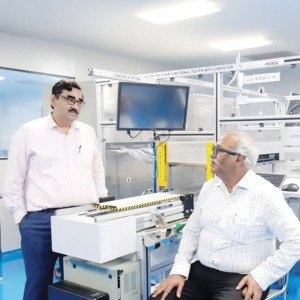
with Sriram Natarajan, Executive Director and CEO
Bigtec Labs in Bengaluru, founded by Dr Chandrasekhar Nair, approached the same problem from an engineering perspective, with funding from CSIR’s New Millennium Indian Technology Leadership Initiative. The team had miniaturised PCR onto a chip.
Sriram Natarajan met Dr Nair at a symposium where he presented that work. The two efforts were complementary: Bigtec had the technological capabilities; Molbio had manufacturing, regulatory and distribution capabilities. They joined hands in 2011 to develop the technology to make it industrial-grade. Bigtec merged with Molbio in 2015 and is now its research division.
The following decade went into validation. CE marking required testing in European populations. WHO endorsement required field data from resource-limited settings. Reputed institutions like ICMR, BIRAC, FIND, the Gates Foundation, the Stop TB Partnership and the Global Fund supported that work.
ICMR validated Truenat in 2017. The WHO endorsed it in 2020. It is one of two platforms the WHO endorses for the initial detection of tuberculosis and rifampicin resistance. It is battery-operated, can run on solar charge, and returns a result in approximately one hour.
Scale of effort

Truenat was installed across Indian primary health centres for tuberculosis before the pandemic. When COVID-19 reached India in 2020, the same machines ran a COVID assay. The network already existed. That is the practical case for decentralised testing.
India’s hundred-day TB campaign ran from December 2024 to March 2025 across 455 priority districts, using portable X-ray and molecular testing, Truenat being among the platforms deployed. The result: nearly 130 million people were screened, of which 7.19 lakh patients were notified, and 2.85 lakh had no symptoms.
Moreover, PCR is one modality. The same access problem applies to radiology and pathology.
Prognosys, acquired in 2022, makes ProRad Atlas Ultraportable, a portable digital X-ray system. iBreastExam, an innovation from UE LifeSciences that Molbio markets and distributes, is a handheld, radiation-free device for breast screening. OptraSCAN, in which Molbio has invested, makes compact whole-slide scanners – OS-Lite, OS-SiX and OS-FLi – supplied without capital purchase.
Two of these address women’s health. Cervical cancer causes approximately 350,000 deaths a year, 94% of them in low and middle-income countries. Truenat HPV-HR Plus detects eight high-risk HPV genotypes – 16, 18, 31, 33, 35, 45, 52 and 58 – which account for roughly 96% of cervical cancers. In a recent evaluation by AIIMS, ICMR and the WHO’s International Agency for Research on Cancer, four Indian HPV assays were tested against international validation criteria. Molbio’s was the only one to meet them fully.
Portfolio of 40+ assays

Over 40 assays run on the platform, including leprosy, HLA-B27, chlamydia and gonorrhoea. These are not large markets. The company solely develops them because the platform is already installed, and the incremental cost of an additional assay is the chip and the development work. A company selecting purely on market size would not build them, but Molbio believes that someone out there still needs the test on time.
The same reasoning applies to outbreaks. ICMR used Truenat during the 2018 Nipah outbreak in Kerala. In May this year, the WHO declared the Bundibugyo Ebola outbreak in the DRC and Uganda a public health emergency; Molbio attended the emergency consultation convened by the WHO and the Africa CDC. Its Ebola assay detects all three viruses associated with large outbreaks. Kits have reached affected areas and validation is under way.
What it has taken
Diagnostics is a long-cycle business. The interval between a working prototype and WHO endorsement ran more than a decade, and very little of it produced revenue.
That interval is where most products fail – not for want of science, but for want of the capital and the patience to finish.
Goa gave Molbio the manufacturing base and the people, most of whom still live in the state. The rest that was needed was time to grow and be perceived as a brand that impacts through innovation and inspiration