



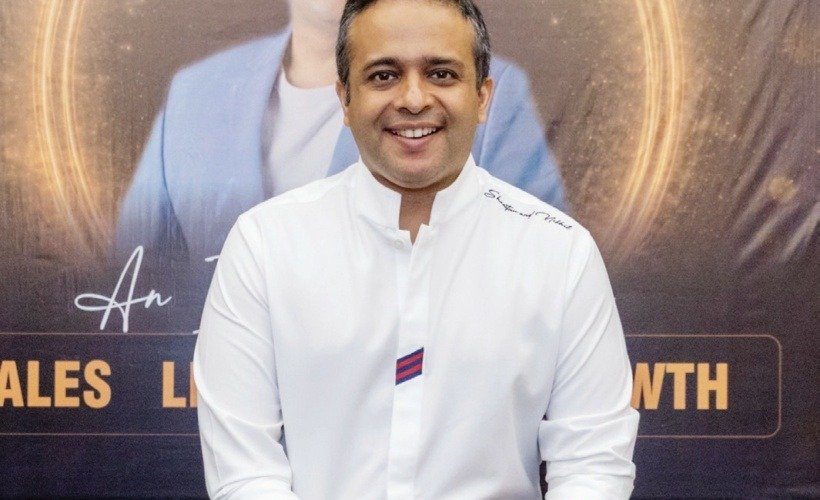
Rajiv Talreja, Business coach and Entrepreneur, elaborates on the mindset shifts required to turn business owners into scale
- How has the profile of the Indian entrepreneur changed over two decades? What worked ten years ago that fails today?
Over the last ten years, the biggest shift I have seen in the MSME founder is openness. Openness to learning, to doing personal development work, to being coached.
Ten years ago, most owners would never have admitted they needed to work on themselves they thought business problems needed business answers. Now they are willing to sit in a room and look at themselves first.
What worked ten years ago and fails today is treating hiring, marketing, systems, and learning as expenses instead of investments.
That belief still shows up everywhere, and it is exactly what puts a ceiling on a business. Ten years ago you could get away with it because everyone around you thought the same way.
Today, the business owner next to you has already made the switch, and if you haven’t, you are the one falling behind.
- You frequently state that the biggest bottleneck in any business is the owner themselves. As a coach, how do you break through an entrepreneur’s ego or deep-rooted habits to get them to see that they are the ones holding the company back?
The downside of being a brilliant business owner without systems is that you start treating yourself as the system.
You start believing you are the answer to every question, every problem. That builds an ego-satisfying, self-fulfilling prophecy that makes you feel like a hero, while the business is completely dysfunctional without you.
I don’t attack that directly. I show them the pattern – you end up surrounding yourself with yes-men who agree with everything you say and cheer everything you do. That is the most dangerous environment for a founder. The only way out of that trap is to consciously create discomfort for yourself, because discomfort keeps you on your toes, keeps you aware, keeps you growing. The real shift is from hero to architect. The system has to be the hero, not you.
- In your experience, what is the most common psychological trap that keeps entrepreneurs stuck in constant “firefighting” mode?
It becomes a wishful fantasy. The business owner is sincere about the goals and the dreams, but that sincerity doesn’t show up in the decisions. They start behaving like a victim of circumstance.
If I had the money, I would have done this. If I had gotten the right people, we would have grown. That story keeps them stuck, not the market. A lot of that comes from being under-resourced, not unprofessional, which is what most people get wrong about MSMEs.
Being under-resourced forces a reactive way of working, and reactive doesn’t serve them or their customers well.
That reactive state is also why founders really burn out. The real burnout is playing the role of sustenance for survival, doing the same things over and over for years, nothing changing. They become robots of responsibility instead of creators of solutions.
What is your coaching framework for helping an intense, control-oriented business owner learn to trust a leadership team and delegate effectively?
What MSMEs get wrong about delegation is they are not willing to trust people, and they are not willing to go through the cycle of developing people before they delegate.
When delegation fails, and it will fail without that development, the owner blames delegation itself.
They never see that the real problem was the absence of development before it. Underneath that is a story almost every founder tells themselves: people will leave, and if people leave, everything will collapse.
The shift I coach them toward is this; people will leave. Knowing that, how do you leverage them fully while they are with you, and give them an experience where they grow? If you are attached to the idea that people should stay forever, you paralyse your own growth.
- When a business owner comes to you completely burnt out and overwhelmed, what is the very first diagnostic question you ask them to uncover the root cause of their chaos?
I ask them: what are you doing today that you were also doing three years ago? Real burnout isn’t hours worked, it’s a founder stuck doing the same low-value, emotionally draining tasks year after year, because some part of them believes nobody else can do it. Once they can answer that honestly, we know exactly where the work starts
- What unique challenges or bottlenecks do you feel Goan MSMEs face compared to those in major tier-1 metropolitan hubs?
The business owners I met there are proof of the same thing I keep saying about MSMEs everywhere outside the metro spotlight.
Underserved, under-represented, under-supported, under-celebrated.
The businesses are just as real, just as capable. What is missing is the access, the capital, the attention a founder in Bangalore or Mumbai takes for granted.
- What is your advice to a second – or third-generation entrepreneur who wants to transition from “working in” the family business to “working on” it without disrupting its core values?
Most second-generation owners inherit a real advantage, the foundation is already laid. The question is whether the first generation is willing to let go and actually empower them to make their own decisions, learn, and grow. Some second-gen founders grow up under the shadow of strong parents and never get to build their own strength because of it, that is the disadvantage. But if the first generation gives them the space, that is a blessing. My advice is aimed as much at the parent as the child: the values don’t get disrupted by handing over control, they get disrupted by never handing it over at all.
- What are the two or three primary foundational systems a local business must implement first before they can safely attempt to scale?
Number one, clarity of your business model. Who is my customer, what problem am I solving, how am I solving it, and at what price?
If you don’t have this clarity, you can’t scale.
Number two, a competent and committed team. You can’t win this game alone.
Number three, your operations can’t be dependent on you, the business owner. That means you need leaders who can manage the business, so you can focus on growth and scale.
- For an entrepreneur stuck in the “Income Driven” phase, what is the single most critical shift they need to make to transition toward Financial Freedom?
Income-driven is not a phase, and it is not a bad end goal.
The whole idea of an end goal is to make peace with what you want from your business.It is less about your business situation at a given point in time, and more about your mindset and behaviour as the owner. If your end goal is financial freedom, your actions have to be aligned to that. That means building leaders and systems. You don’t jump from one goal to another. Your business can be struggling right now, and your end goal can still be financial freedom or legacy. Your business can be doing fine right now, and your end goal can still be income-driven.
- The Business Inner Circle (BIC) is built as an accountability ecosystem. Why is mutual peer accountability more effective for long-term business growth than just passing leads?
The growth of an MSME is directly proportional to the competence of the business owner. You don’t learn or enhance your competence by getting referrals. Referrals are great, but they don’t solve the root cause of why a business is struggling. A business struggles because of a lack of systems, strategy, and skill in the business owner. That is why BIC is focused on learning and peer accountability, so business owners don’t just learn; they take action on it at the same time
From Business Crisis to Building Business Inner Circle (BIC) Goa: Why Continuous Learning Matters

There was a time when I seriously considered shutting down my business.
Years of investments, mounting loans, financial losses and the impact of COVID had brought the business to a point where continuing seemed almost impossible. Yet, I soon realised that shutting down a business is not as simple as making a decision on paper. Behind every business are years of effort, relationships, commitments, people and dreams.
I decided that before giving up, I would make one more attempt – to learn.
I began attending free online workshops, business coaching sessions and programmes conducted by different mentors. I was looking for practical knowledge that could help me understand what I was doing wrong and, more importantly, what I needed to do differently.
That journey eventually led me to one of Rajiv’s free workshops.
I found considerable value in his approach and decided to take the next step. I enrolled in subsequent programmes and eventually in the paid programmes as well. The learning had a tangible impact on my business.
I was able to rethink and revamp the way I operated, expand the business and, most importantly, develop a second line of leadership within the organisation. Building leaders within the business gave me the ability to grow without having everything dependent on me.
That experience changed my perspective.
I realised that many small and medium-sized businesses and family-owned businesses face challenges not because they lack hard work or commitment, but because they often don’t have access to the right knowledge, systems, expertise and contemporary business practices.
I wanted to bring that opportunity to business owners in Goa.
The Beginning of BIC Goa
BIC had already been launched as a pilot initiative in several cities across India. Following its successful implementation, the organisation began looking at opportunities for wider expansion.
Goa, however, was not part of the immediate plan.
I approached Rajiv with the idea of bringing BIC to Goa. His response was encouraging: if I was willing to take the initiative, he was willing to support it by bringing in experts and providing the necessary guidance.
That willingness to support an idea that wasn’t originally on the expansion map eventually led to the creation of BIC Goa.
For me, it was not simply about launching another business platform. It was about creating an ecosystem where business owners could learn, exchange ideas, access expertise and prepare themselves for the realities of a rapidly changing marketplace.
Why Businesses Need More Than Networking Today
Networking and referral marketing continue to have an important place in business. They can create relationships, generate referrals and deliver immediate opportunities.
But I believe that they can no longer be the sole engine of sustainable business growth.
In earlier generations, much of business growth depended on word-of-mouth. Today, networking and referrals can play a similar role – but scaling a business requires much more.
Markets are evolving rapidly. Customer expectations are changing. Technology is transforming business models. Competition is no longer restricted by geography. Digital platforms have changed how customers discover, evaluate and engage with businesses.
In this environment, business owners cannot afford to stop learning.
The businesses that will remain relevant are those whose leaders continuously update themselves – understanding changing customer behaviour, emerging technologies, market trends, new business models and evolving competitive dynamics.
Learning helped me move from a point where I was contemplating shutting down my business to a stage where I could restructure, grow and build leadership within the organisation.
My Role in BIC Goa
My objective through BIC Goa is to facilitate access to this kind of learning for business owners across Goa.
I want to create a platform where entrepreneurs, MSMEs and family-business owners can step away from the day-to-day pressures of running their businesses and look at their organisations from a larger perspective. Because sometimes, the difference between a business that struggles and one that grows is not simply capital or effort. It is the willingness of its leadership to learn, adapt and evolve.