“I feel strongly that intelligent and insightful thoughts need to be shared with a wider audience”
9 November, 2026
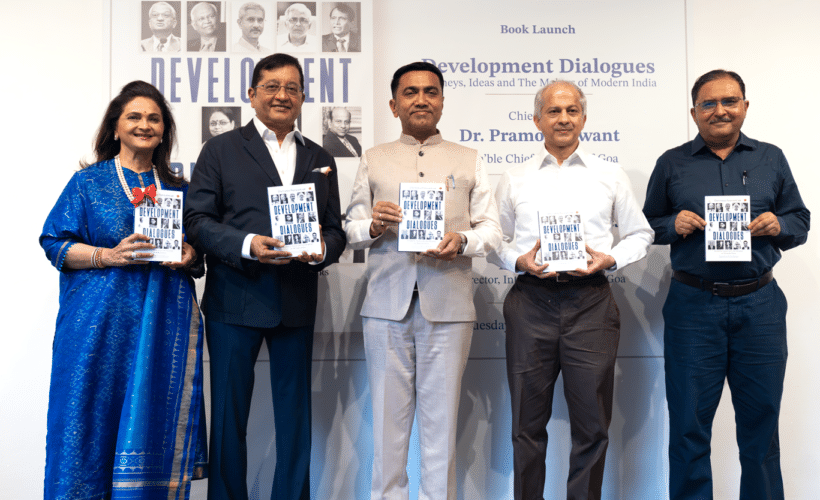
Dattaraj ‘Raj’ Salgaocar released his book Development Dialogues: Journeys, Ideas and the Makers of Modern India, recently. The book release was followed by a conversation between Salgaocar and Dr Pushkar, Director of The International Centre Goa
Congratulations on the book. It has been in the making for quite a few months, and you must be relieved. I think it was around 12 to 18 months ago when you decided this needed to be turned into a book. Could you walk us through that decision?
The idea came after we conducted the initial interviews. We first listened to the recordings and did a raw transcription, which was a bit all over the place because it was done online. At one point, I turned to you, Dr Pushkar and said, “This needs to be a book.”
We were fortunate to host a wide range of brilliant minds for these conversations, something that isn’t typically easy to pull off, especially in a place like Goa. Because of the COVID-19 pandemic, people had more time on their hands. Additionally, our trustees helped connect us with key leaders; Dr Mashelkar put us in touch with several people, including Vijay Govindarajan. It was a great combination of effort to bring these exceptional minds together.
When I reviewed the interviews on YouTube afterward, I realized that when you are interviewing live, you don’t always catch the full depth of their responses. I felt strongly that these insights needed to be shared with a wider audience, particularly young minds and students; showing them how these leaders built their careers, and how many of them were driven not by money, but by a larger mission to make India strong.
Take Dr Mashelkar, for instance. He had numerous lucrative opportunities abroad, yet he chose to serve India. The same goes for Dr Anil Kakodkar, Dr Madhavan Nair, Suresh Prabhu, and Dr Ritu Karidhal. It was fascinating to see how these individuals sacrificed personal gain for a higher purpose. I thought compiling their stories into a book would provide inspiration and guidance for young people, especially as India continues on its current growth trajectory.
Dattaraj ‘Raj’ Salgaocar with his newly released book, Development Dialogues: Journeys, Ideas and the Makers of Modern India
Reading the text feels much sharper than watching live, unscripted interviews. I know it is hard to pick favorites, but were there two or three individuals or specific discussions that stood out most to you?
Asking that is like asking a parent to choose a favorite child! They are all equal to me. It is extremely difficult to pick because each person comes from a completely different background. Some came from privileged beginnings, while others came from severe poverty.
Consider Rajan Anandan, Head of Google India and currently serves as a Managing Director at Peak XV Partners (formerly Sequoia Capital India and SEA), where he leads Surge, their rapid scale-up program for early-stage startups. His brother was an exceptional swimmer, and his father swam the Palk Strait. Anandan spent his first 15 years trying to become a professional sportsman, failed at it, and then transitioned into business.
Then look at Dr Anil Kakodkar. He shared that whenever he brought home a test score of 100, his mother would say, “That’s good, but why did you get a 95 in the other subject?” That constant drive for excellence shaped him.
Or take Dr Ritu Karidhal, who came from an average family. As a child, she would look up at the stars, and her mother encouraged her to study space. Back then, pursuing space science was an unusual ambition, yet she went on to lead India’s Mars Orbiter Mission.
None of these leaders were inherently privileged. They came from humble backgrounds, worked hard, and made a lasting mark for themselves and the country.
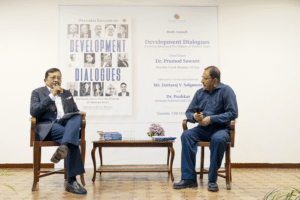
Is there a particular section or story from the book that you wouldDattaraj ‘Raj’ Salgaocar in conversation with Dr Pushkar on the making of the book
like to share with our readers?
I really appreciated the insight on happiness shared by Tenzin Priyadarshi from the Dalai Lama Center for Ethics and Transformative Values at MIT.
He notes: “One irony about happiness is that the pursuit of happiness simply remains a pursuit. It is a fleeting pursuit rather than an experience of recognition. A degree of self-awareness is required to understand what would really make us happy. Often, social norms dictate that happiness is tied to accomplishments, wealth, personal capital, or relationships. While these might contribute to a temporary sense of joy, they don’t fundamental shift how we view ourselves or the world.
To me, happiness should be approached in simplistic terms, we don’t need a complex checklist of pre-requisites. Otherwise, we procrastinate. We tell ourselves we must endure misery until we turn 60, achieve everything on our list, and only then start enjoying life. More often than not, people pass away before ever experiencing genuine happiness because of this delay.” I found that perspective deeply insightful.
I was also struck by the story Professor Vijay Govindarajan shared about the two horses; the horse you can control and the horse you cannot. Can you elaborate on that?
Professor Govindarajan brought up the analogy of a carriage drawn by two horses: one within your control and one outside it.
His advice is simple: always focus your energy on controlling the horse within your reach. If you spend your life trying to control the horse outside your command, you will end up frustrated, cynical, and depressed.
He applies this principle regularly and advises top corporations and family businesses to master what is within their control before moving forward. All these leaders share simple, everyday examples, but their lessons carry immense depth.
As a final question, if you had to do this entire project over again, what would you do differently?
I would certainly love to do it again, but as you get older, your role shifts toward mentoring. I would prefer to hand the execution over to a younger team so they can experience the joy and learning that comes with the process.
It was by no means an easy task. We faced challenges with internet connectivity, editing, and logistics, but we thoroughly enjoyed the journey.
Receiving positive feedback from our trustees like Yatin Kakodkar, Shrinivas Dempo and my peers made it deeply satisfying. Ultimately, if you enjoy the process, the results speak for themselves.