



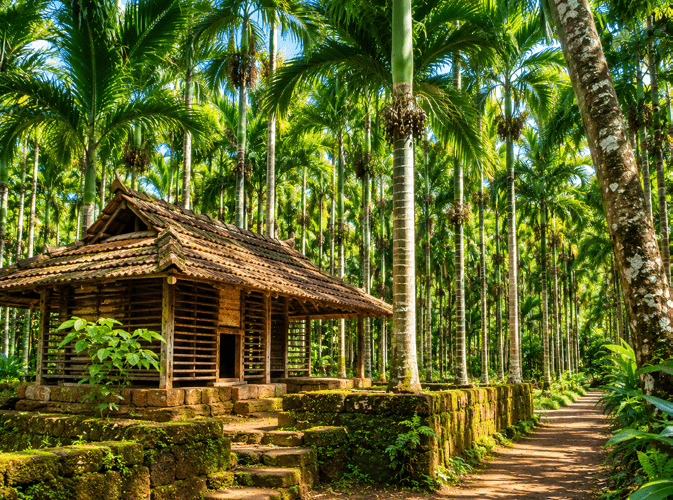
By merging ancient homestead wisdom with modern waste-to-wealth science, the Konkan region is showcasing a sustainable blueprint to rescue soil health and secure self-reliance
The lush Konkan region, stretching across Goa, Maharashtra, and Karnataka, is blessed with an extraordinary diversity of tropical flora and fauna due to its close proximity to the Western Ghats. For generations, local farmers have quietly nurtured this ecological wealth through a traditional, ancestral homestead gardening system transmitted from their ancestors called ‘Kulagar.’ This intricate method of multi-storey farming integrates areca nut and coconut trees with spices, medicinal plants, local vegetables, and flower plants in a meticulous way. Far from being a simple backyard garden, the Kulagar is a sophisticated, integrated farming system designed to conserve natural flora, protect precious soil, and preserve natural water resources while maintaining traditional crops and technologies.
A National Campaign for Soil Health
With an aim to promote organic farming across Goa and reduce excessive dependence on chemical fertilisers, the Indian Council of Agricultural Research-Central Coastal Agricultural Research Institute (ICAR-CCARI) is actively promoting this ancestral homestead gardening system. The concept forms the focal point of ICAR’s nationwide intensive campaign, Khet Bachao Abhiyan, which runs across the country throughout June as a clarion call to protect soil health and safeguard India’s agrarian heritage. This campaign strictly follows natural farming methodologies designed to rejuvenate and improve soil health. Beyond agricultural productivity, the project aims to promote the widespread adoption of natural farming across Goa; strengthen local cow conservation (Gauseva) initiatives; preserve and revitalize India’s ancient ‘Rishi-Krishi’ traditions; and foster sustainable, long-term agricultural practices in the region.
The Power of Circular Agriculture
The foundational principles of this system remain incredibly relevant today. ICAR-CCARI Director Dr Parveen Kumar explained that the essence of the Kulagar lies in its circular philosophy, which revolves around bio-resource conservation, crop diversification and, crucially, the recycling of resources. He noted that in an era dominated by concerns over dependency on synthetic chemicals, the Kulagar stands as a beacon of Integrated Nutrient Management (INM). Dr Kumar emphasized that by utilising on-site biomass, such as green manure and farm-derived organic matter, these homesteads minimise the need for external inputs.
Turning Waste into Wealth
However, even the most sustainable traditional systems face modern pressures, particularly when managing agricultural waste in areca nut-growing regions. One acre of areca nut cultivation generates up to 1.2 to 1.5 tonnes of husk annually, which does not decompose easily. To address this challenge, ICAR-CCARI is promoting the adoption of a specialised compost culture that accelerates the decomposition process. Dr Shripad Bhat, Senior Scientist (Agricultural Economics) at ICAR-CCARI, explained that this technology converts tough areca nut husk into nutrient-rich compost within six months. He added that the intervention eliminates the need for residue burning and produces high-quality compost that is naturally rich in potash, providing an excellent organic input for balanced crop nutrition. Following successful demonstrations at benchmark farmers’ fields, Dr Bhat stated that the technology will be scaled up across Goa through a wider dissemination programme that leverages peer learning and local success stories to encourage adoption. By embracing this dual approach, he noted that they honour the legacy of their ancestors who built these Kulagars while contributing to a larger national mission of environmental stewardship.
Empowering the Next Generation
The success of these scientific interventions relies heavily on a new generation of farmers who are introducing advanced production technologies to this traditional system.
By taking it to new dimensions like value addition and processing, agro-ecotourism, and on-farm conservation of genetic resources, they are proving that ecological resilience can walk hand-in-hand with economic growth. The Kulagar system effectively combines crop diversification, recycling of resources, organic production, water harvesting, and soil and water conservation to create an exclusive, sustainable system for horticulture crop production.
Reclaiming Self-Reliance
As the Khet Bachao Abhiyan mobilises millions across India, ICAR-CCARI expects Goa to lead the way by demonstrating how the wisdom of traditional homesteads, combined with the latest advancements in balanced fertilisation and Integrated Nutrient Management, can secure both livelihoods and the environment.
Dr Gopal Mahajan, Senior Scientist (Soil Science) at ICAR-CCARI, stated that the future of farming in Goa lies not in increasing dependence on synthetic inputs, but in reclaiming self-reliance through the sophisticated, diverse and inherently sustainable Kulagar system. He added that the Khet Bachao Abhiyan serves as a timely reminder that the path towards a Viksit (developed) and Swayampurna (self-reliant) Goa is paved with both innovation and tradition. As they observe this campaign, Dr Mahajan urged that everyone must recognise that the Kulagar is more than just a garden; it is a laboratory of ecological resilience.
Refining Tradition with Modern Science
Ultimately, the revitalisation of this system demonstrates that transitioning to a sustainable future does not mean abandoning the past.
Assistant Chief Technical Officer Rahul Kulkarni highlighted that the initiative demonstrates that integrating the right source, right dose and right timing of nutrients can enhance yields while protecting the delicate ecological balance of the Western Ghats. In conclusion, Kulkarni noted that the transition towards a more sustainable agricultural paradigm does not require people to abandon the practices of the past, but rather to refine them with the precision of modern science.