



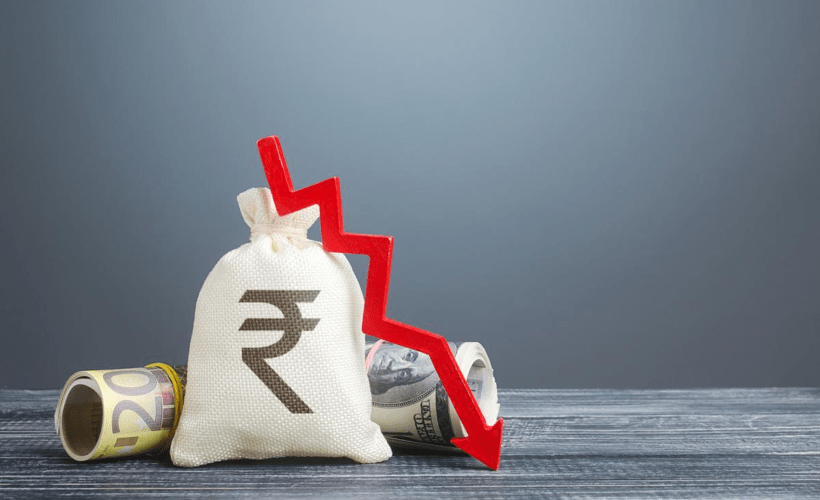
Nandini Vaidyanathan explains currency fluctuations and how entrepreneurs can minimize its impact on their businesses
1947 was a great year. Not only did India become independent but the exchange rate of rupee against dollar was 1:1, that is 1 rupee was equal to 1 US dollar! Steadily it has declined over the subsequent decades hitting rock-bottom in late 2025 when 100 INR=1.11 USD. So does this spell doom for the Indian economy as a whole or is there some bright spot? The biggest winners of course are those entrepreneurs who earn bulk of their revenue in USD while incurring costs in INR. The biggest gains here are that the value of their earnings in USD goes up significantly, they become more price-competitive in the global market as they are able to leverage cost arbitrage and as a result become very attractive to foreign investors who get more bang for their buck.
The biggest losers, conversely are those who depend heavily on imports for their product, whose business model is driven by technology imported from dollar countries, and whose market largely is domestic. These entrepreneurs take a big hit as costs of inputs put extreme pressure on their operations, to the extent of outpricing them even in their home markets and making them rethink their whole business strategy. Additionally there is also pressure both from debt and equity investors who make a beeline to hedge their risks by withdrawing their investments in such companies.
The rupee-dollar fluctuation is nothing new to the Indian economy. And every entrepreneur worth his salt should be able to factor this into his business model right from the moment he decides what his product is and who is going to buy it. The trouble is most entrepreneurs don’t; their only focus is on their product. I have repeated this ad nauseum that they are focused on their product to the exclusion of even their customer! Entrepreneurship is not just about converting an idea into a product; it entails envisioning the organization around the product that will make the business stable, sustainable and profitable. I remember when I bought my Kinetic Honda somewhere in 1985 in New Delhi. It was the first automatic scooter on Indian roads. One day I stopped at a gas station to fill gas. I heard one attendant tell the other in Hindi, and I am paraphrasing it here: this is the new scooter, it moves on its own. The rider just has to sit on it (it sounds much better in Hindi, the essence is lost in translation)!
For most entrepreneurs, their businesses are like this Kinetic Honda. They believe that their responsibility ends with building a product. The business is expected to ride on its own, anticipating the road conditions, the dead-ends, even the road map. The only rein the entrepreneur expects to take control of is the product. This is the reason why every year we see the demise of many businesses that seemed to be having a successful run, but are now hitting a road block!
Like I said earlier, currency fluctuations are as natural as breathing in and breathing out. There are two strategies that entrepreneurs should take on board to manage the ripple effect of the fluctuations on their business. And both of these are ingrained into our Indian ethos. One is, don’t put all your eggs in one basket. Which means do not be solely dependent on imports. You may have a 100 per cent import bill to start with but you need to work on developing domestic vendors so that over time your import substitution can drastically bring down your input costs.
The second is, when you lie down; do not stretch beyond your mattress. Which means do not overcommit your resources in a manner that will cause the downfall of your business. Draw your boundaries and your capabilities clearly. Align them to your vision in a sensible fashion. Do not contribute to the downfall in the economy.
Some of the steps entrepreneurs can take to minimize the sudden impact of currency fluctuation on their business is :
• Using financial instruments such as forward contracts (pre-fixed sale price between parties for a future date), futures contracts (pre-fixed on stock exchanges), options (one party pays a premium at the outset to protect the price within a time frame).
• Developing a macro perspective on global trends to anticipate sudden shifts and putting counter measure in place instead of waiting till they actually happen (e.g. if you notice a political unrest brewing within your market, use predictive models to anticipate the domino effect it may have on your business in the future).
• Most importantly, diversify so that you are not dependent on one market for sourcing your inputs and for selling your product.
To quote the Cheshire Cat, “If you don’t know where you’re going, any road will take you there!”
The columnist is a published author, entrepreneur, business consultant, industry commentator and mentor to startups. Email: nandini@carmaconnect.in