



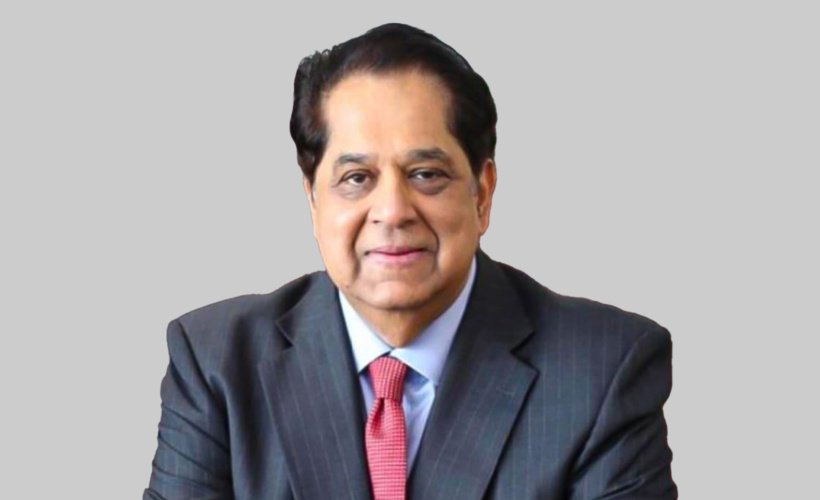
K V Kamath reflects on India’s journey towards becoming a Viksit Bharat by 2047, highlighting the long growth runway ahead, strong balance sheets, and the transformative role of infrastructure, digitalisation, and technology in sustaining long-term economic growth. Kamath delivered the keynote address at Goa Management Association’s 50th Annual Day.
We have a glorious 25 years ahead of us; the runway for Viksit Bharat. The first thought that comes to mind is, “Why do we say that we have a 25-year runway and how does that underpin growth?” Very simply put, I look at what needs to be done going forward for our country to get to this status. All we need to do is look at the infrastructure effort that is required to start with, whether it is urbanisation of cities, whether it is rejuvenation of the urban centres, whether it is building road networks, the highway networks, the expressway networks, the rail networks, the seaports, and the airports. Of course, I would not forget green power and green energy, as well as data.
A whole lot of things, which we have not seen at scale – we have only seen incremental buildup – will need to be put in place if we need to achieve a Viksit status by 2047, which is broadly the date that has been articulated by our leadership.
Let us understand whether this has been done before, or are we talking in isolation? I look back at Japan in the 1960s, because that’s a good start point to see how development has taken place in other countries over a long period of time. Japanese development started in the late ’60s, and then it had momentum for about 25 years.
I will give you two data points which will put in place the challenge and the opportunity. When the journey started in Japan, in the late ’60s, the Yen to the Dollar was ¥350 to the Dollar. When the journey ended in the early 1990s, the Yen was less than ¥100 to the Dollar. You can see that there is a lot of strength and muscle that the economy built over a long period of time.
There are two other interesting points which will also put in place what we will see as fruits of this growth.
At the start of the journey, interest rate in Japan was around 8% and inflation was 8%. At the exit in the early ’90s, interest rate and inflation both were near 1%. Of course, growth also fell very rapidly in the early ’90s and thereafter. That is also something that we may have to keep in mind.
The other example that I will use is China. China is, in a way, a more fitting example for us because the population was maybe like to like. I would think that Chinese growth really started around the year late ‘90s (’97 -’98), and in a way, tapered off by 2015 or 2016. The country has been growing, but all that is to be visibly seen was done by then. Let us look at what happened by then in those 15-17 years. The economy grew from around a trillion dollars to something like 15-16 trillion dollars, all in the space of those 15-18 years of growth. Very interestingly, their currency also strengthened from 8.5 Yuan to the Dollar to around 6.5/7 Yuan to the Dollar over this period. The interest rate and inflation rate were at around 8% and both declined dramatically. The interest rate came down to around 2.5% and inflation to 1-2%.
This, in a way, shows that once you light the fire or ignite the growth cycle, this is almost like a perpetual motion engine. That is what we are seeing in India at this point in time. We need to make clear that we stick to our growth path and then do not waver from it as we drive down on this path. This is going to be a long-run journey. It is not going to be a short journey. It is not going to be a stop and start journey, as we go along.
Using these two examples and looking at the India story, I see many likes or similarities. For example, the infrastructure effort all got done in China during this period, and we are just now getting on to that effort. A lot has been done in the last 10 years. If you look at the highway network, the port network, the airport network, the telecommunication network, a whole lot has been done.
But a lot more needs to be done. Particularly, where we are behind is in urban regeneration. It is rebuilding of our cities to make them look and feel like a modern city in a Viksit Bharat. That is a huge effort, and that is underway, as I see. So I am clear that the long-run growth momentum and the long-run growth drivers are in place, and the government is executing on this.
I want to look at two other reasons, two other points that are always raised. Couldn’t this have been done earlier, and couldn’t this have been done faster? My answer is, in a way, we are at the right time.
To drive growth of this order and achieve what we need to achieve, certain preconditions exist in the system. The main preconditions are a question oft asked, where is the funding going to come from? And I think the answer to that is available today. We need two things for funding to come. One, strong corporates, clean balance sheets, and strong cash flow of corporates. Similarly, strong banks, clean balance sheets with lending resources. The third pillar, which is a strong capital market, with the ability to lend long term.
If you look back, we did not have the third pillar at all for a long, long time because there wasn’t enough long term saving in the system, whether it is through pension funds, insurance companies or mutual funds. We did not have that saving base. But today, that saving base is growing at a faster pace than probably the banking base. That is able to provide the long term funding that is required for this sort of investment in building a Viksit Bharat. That is, funds with maturities of 7, 10, 15, 20, and even 30 years at fixed rates, which the person implementing the project is comfortable to borrow and invest.
I am sure that all three pillars are now firing. Corporates have a clean balance sheet. I can say this, that in my 55 years of banking, I have not seen cleaner corporate balance sheets. The overall systemic leverage is less than 0.5:1. If you look at the top 50 companies in the country, they are probably even lower than 0.5:1, i.e.; the debt to equity ratio.
Similarly, if you look at bank balance sheets and the leverages that they would provide to Corporate India, Corporate India used to borrow primarily from banks, and Corporate India’s leverage was almost 3.5/3.7:1, i.e.; at the turn of the century, in the year 2000. By the end of the first decade of that century, in the 2000s, corporate leverage came down to around a little under 2:1. Now, as I said, corporate leverage is, just with a small rounding error I would say, less than 0. 5:1. In most cases, hardly any debt, except for working capital.
How has this magic happened? I think we tend to forget that, in a way, India reinvented itself during COVID. We reinvented ourselves during COVID and became more efficient. I won’t go into that whole story of how we did it, but when I talk to industry, they say this was through a better understanding of what we needed to do to survive in the COVID period. You needed to be more efficient. You changed the processes, you put in some automation, and you suddenly found out that your bottom-line was getting healthier and healthier. Indeed, by the time we were out of COVID, Corporate India had started the cleaning-up process of their balance sheet. Thereafter, if you see, every second corporate that you talk to or look at, has a free cash flow of 300 to 500 crores.
With these sort of numbers, corporates today will be able to put in growth capital themselves. They won’t need to borrow from banks. That is why the deal averaging has worked and has stood to good stead. So this is the first pillar that wasn’t available in the past. I gave you the type of leverage we were running, you know 10-15 years back and where we are today. The clean-up happened at corporate level. The clean-also happened at the banking level.
The second cleanup that I would see as a cleaner balance sheet is the central balance sheet, that is the government’s balance sheet. If you look at the government’s balance sheet and if you look at the fiscal (balance sheet), we are one of the tightest managed fiscal situations of any country. Now if you link inflation to that, we have inflation under control. That would mean we would get interest rates also to where the rest of the world operates on, significantly below where we are today. In the next 6 months or 1 year as inflation continues to hold; we will see this. Inflation coming down today is structural. It has come down in a structural manner, and it will continue to hold at this level. That I think is comfortable.
Then there used to always be a problem of the current account, the external account. But that also now is at a comfortable level, with the regulators and the monetary policy authority confident to hold it in the 1% range or so. So, I think as far as management of the government finances is concerned, again, you have a clean situation, which lends itself to growth at an accelerated pace.
The third side to the clean balance sheet is the retail balance sheet. Where retail consumers, you and me, if we were borrowers, what is our balance sheet? I think India is one of the lowest retail debt to GDP ratios anywhere in the world. That will stand in good stead even as we grow in rapid pace and aspirations increase.
To wrap this up, there is an asspirational side of growth. As per capita incomes cross certain thresholds, certain things get triggered. I used to always say, having spent time in Southeast Asia during the 80s and early to mid 90s, that at around $750-$1000 per capita income, you suddenly aspire for a few things, like you want a car or something to move around with. You want a home. You want things to put in that home. Which means retail credit has to be there. If you remember, till the year 2000, retail credit was not really available. Except for one company providing home loans, there wasn’t anybody. At that time, ICICI Bank came in and opened up the whole retail window and then, of course, a miracle happened and everyone else got this engine going, and retail funding became available to the consumer. Today that is no longer an issue. Between the banks and the NBFCs, you have a very robust system for financing the retail side of the business. As I said, it is not overleveraged, it is underleveraged if you look at the global context. So we are at a comfortable position even there.
So, to map – the opportunity is there, a long runway is there, balance sheet and things that make growth happen are already in place.
The last element that I wanted to talk of before I conclude the sharing of my thoughts with you is the digital revolution that is happening in India. I will speak about it in 2 parts. One is the digital ecosystem what I call the digital super-cycle. Probably 150,000-200,000 digital firms have been set up, digital and fintech both put together. Some of them are in startup stage, some of them are mature but all of them are contributing significantly to the economy. I would guess that over the next 5 to 10 years, the digital ecosystem, the digital drive for the economy will be equal to probably between 20-25% of the overall GDP. So, a big driver which has yet has not come to the table, as it were, but is just around the corner, is the digital ecosystem that is being built.
Now there are some other fundamental things that are happening to this digital ecosystem. One, the dividend that we have from young users. They are what I call digital natives. They are driving this economy so they will contribute to the GDP growth in a significant way, or their usage of this economy will contribute to the GDP in a significant way.
Second is what I call the Democratisation of the Technology Infrastructure. By democratisation of technology infrastructure I would mean, technology infrastructure today is available to everybody. Everybody around us has access to technology and uses technology in a very efficient and effective way for his or her purpose. So, technology, in a way, is democratised.
The third thing that I want to say is that technology has become ubiquitous. Today you look at your device in your hand, that does multiple functions. Nobody thinks about it. It used to be a phone, then it became a camera, then it became a mailbox, then it became so many other things, using which you connect to the outside world. To top all this up, you have AI revolution that is happening.
Just to put it into context, about what AI revolution means to all of us and a question that again arises is, are we late to the party? My honest answer is, No, we have never been late to the party, we have been just in time. You take the green revolution as an example; if you were to have put in all the investment that we wanted in 2010, we would have not been viable in the green economy. But today when a chip, the solar chip, has come to a costing that we have today, it is cheaper than fossil fuel. So, clearly we were not late to the party.
Then they said, are we late to the entire data revolution? People thought we were. Again, this was about 10-12 years back. But you can now clearly see that we could not have afforded the cost of those days but at today’s cost where we are the lowest cost provider of data, I think we certainly can say that we can consume as much as you want and we can afford it. So, we were not late to the party.
Similarly in the AI revolution, I think we are coming in now that the right time and we will effectively utilise this. I had asked somebody who is well known in this field, artificial intelligence field, who was my former colleague at Infosys, Vishal Sikka. This was some 6-7 years back. In technology we always use this phrase ‘Moore’s Law.’ Moore’s Law, simply put, states that every 2 years the price performance of technology improves by a square. So I asked Vishal Sikka what is the equivalent to Moore’s Law for AI? He said, every 3 to 4 months, price performance doubles. Simple arithmetic would show you that in a year it is about 10x. That is the sort of acceleration. This was a few years back and today probably by anecdotal evidence, I would think that the price performance is doubling ever 1½-2 months. That is the rate and pace of change we are seeing and that is what India will thrive on. We are not late to the party in all these things; we were I think right timed. We have come in at the right time. So, on the back of all these drivers, we are progressing on our Viksit journey.
I use a simple yardstick, if we are growing at 7 or 8%, I would think that actual drivers of economy whether it be manufacturing, services, these sectors will have to grow at a significantly higher rate than this. The opportunity is always there, growth is there and we will see India charting this path as we go along.
Finally, just to sum up what I have said. The path is, we have a long runway, we are prepared for this runway, we have all the enablers in place, we are right timed in terms of using all the developments that have taken place and in these developments, the cost of a unit of implementing something has come down dramatically. Our journey, I think, is going to be exciting, smooth and we will certainly be Viksit Bharat in the next 23-24 years.
What I look forward to is, quickly in the near future, within a year or so, crossing 5 trillion as an economy and then just another 4 to 5 years crossing 7-8 trillion and then, we will accelerate our pace thereafter. After that, we should look at doubling from 7-8 to 16 trillion and that is the leap we will have to take to get to Viksit, because that’s the next step. So we have enough things to do on this journey, and I think we are well prepared.